la cama
bed
Plural: las camas
Explore four rooms, learn 24 everyday objects, and practise 12 things you might say in a home. Includes audio, recall practice and printable worksheets.
Choose a room, then choose an object.
Interactive room view needs JavaScript. The complete words and phrases are listed below.
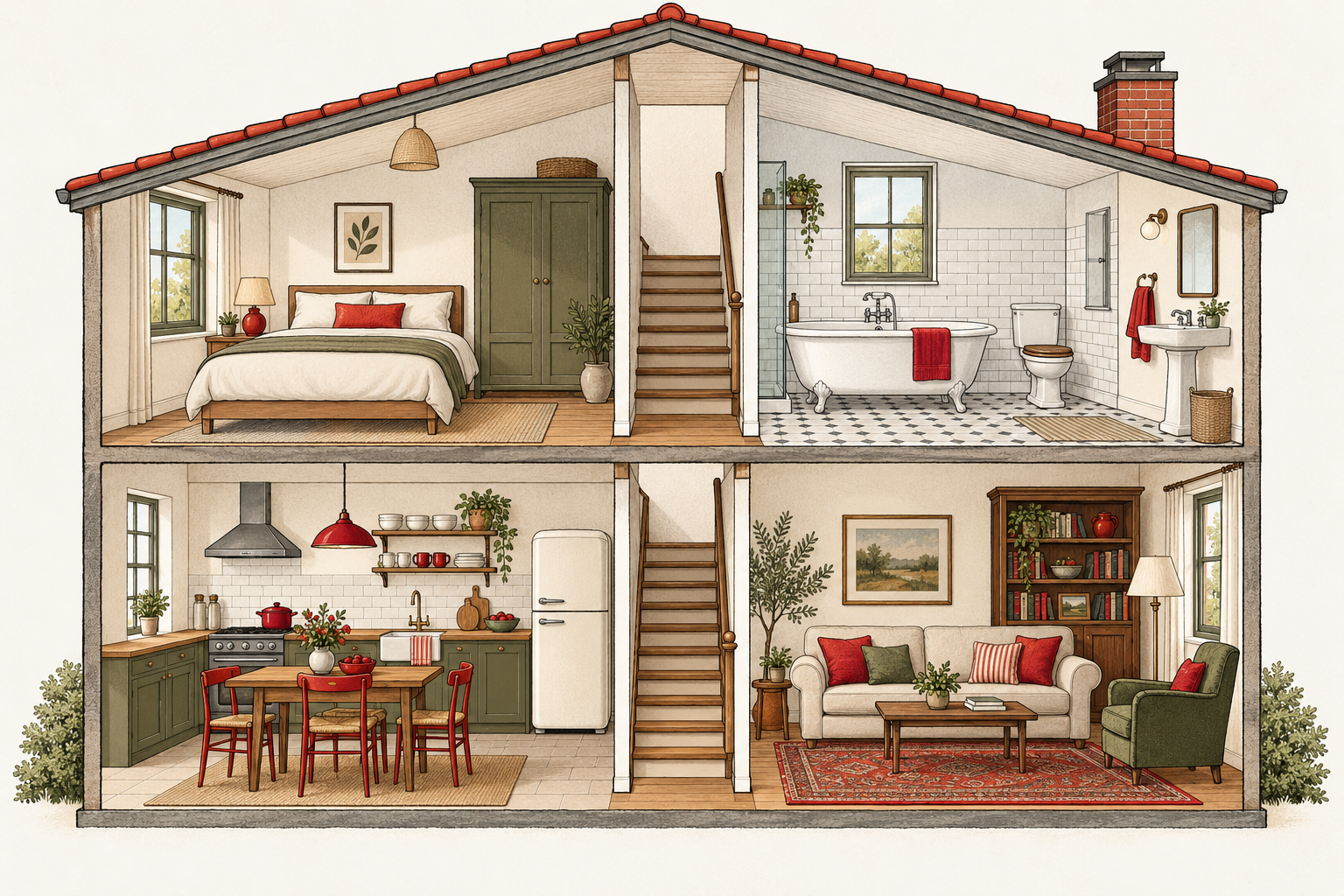
Audio uses synthetic voices and plays Spanish, English, then Spanish. Word recordings use the singular form with its article.
Start with the English meaning or situation. Reveal the answer when you’re ready.
Your answers stay in this page for this round only. Think of your answer or type it; nothing is sent anywhere.
Read all four room names, 24 object words and 12 phrases below.
Plural: los dormitorios
bed
Plural: las camas
pillow
Plural: las almohadas
The white pillow at the head of the bed. A decorative cushion is un cojín.
blanket
Plural: las mantas
The folded green blanket across the bed.
wardrobe
Plural: los armarios
window
Plural: las ventanas
bedside table
Plural: las mesillas de noche
Also called una mesa de noche.
¿Puedo abrir la ventana?
Can I open the window?
Situation: You want to open the window. Ask for permission.
¿Me traes una manta, por favor?
Could you bring me a blanket, please?
Situation: You feel cold. Ask a friend to bring you a blanket.
¿Dónde puedo dejar la maleta?
Where can I leave my suitcase?
Situation: You have arrived with a suitcase. Ask where you can leave it.
Spanish often uses la where English uses my when ownership is clear from the situation.
Plural: los baños
bathtub
Plural: las bañeras
washbasin
Plural: los lavabos
The bathroom basin. The kitchen sink is usually el fregadero in Spain.
toilet
Plural: los inodoros
The fixture, not the room. El baño names the bathroom.
towel
Plural: las toallas
mirror
Plural: los espejos
tap / faucet
Plural: los grifos
La llave and la canilla are other words you may hear for a tap.
¿Dónde están las toallas?
Where are the towels?
Situation: You need a towel. Ask where the towels are.
¿Dónde está el baño?
Where is the bathroom?
Situation: You are visiting someone. Ask where the bathroom is.
No hay agua caliente.
There's no hot water.
Situation: The shower water stays cold. Explain the problem.
Plural: las cocinas
cup
Plural: las tazas
The red cup on the shelf. Taza can also mean mug.
plate
Plural: los platos
table
Plural: las mesas
chair
Plural: las sillas
fridge
Plural: las neveras
El refrigerador is another word for fridge.
cooking pot
Plural: las ollas
The red cooking pot on the hob.
¿Quieres un café?
Would you like a coffee?
Situation: You are making coffee. Offer one to a friend.
¿Dónde están las tazas?
Where are the cups?
Situation: You are helping in an unfamiliar kitchen. Ask where the cups are.
¿Me pasas un plato, por favor?
Could you pass me a plate, please?
Situation: You are setting the table. Ask a friend to pass you a plate.
El salón is another common name for this room.
Plural: las salas de estar
sofa
Plural: los sofás
armchair
Plural: los sillones
rug
Plural: las alfombras
lamp
Plural: las lámparas
bookcase
Plural: las estanterías
cushion
Plural: los cojines
The red cushion on the sofa. A bed pillow is una almohada.
¿Puedo sentarme aquí?
Can I sit here?
Situation: You want to sit beside someone. Ask whether you can sit here.
¿Puedes encender la luz?
Can you turn on the light?
Situation: It is getting dark. Ask a friend to turn on the light.
¿Dónde dejo la bolsa?
Where should I put the bag?
Situation: You have brought a bag of shopping. Ask where to put it.
Here bolsa means a shopping bag, not a suitcase.
The requests with tú are for someone you address informally, such as a friend or housemate. The words here are one useful set, not the only names used across the Spanish-speaking world.
For more room names and examples with hay and estar, read rooms of the house in Spanish.